
False Questions in Science: When Precision Fails the Question
A Warmup: The Impossible Triangle from In Our Prime
Sometimes, a question looks simple—but hides an impossible premise.
In the Korean movie In Our Prime, a teacher draws a right-angled triangle with two identical legs. The height is given as 6, and the hypotenuse as 10. He asks the students to find the area.
Using the common formula:
Area = 1/2 × base × height = 30
The calculation seems straightforward, but the teacher says the answer is wrong.
Why?
Because the triangle described cannot exist.
A right-angled triangle’s hypotenuse is the diameter of its circumcircle. This means the height (the perpendicular from the right angle to the hypotenuse) acts as the radius of that circle.
If the hypotenuse is 10, the radius must be 5. The height being 6 is impossible geometrically.
This example reveals a false question—not because of a calculation error, but due to an impossible premise.
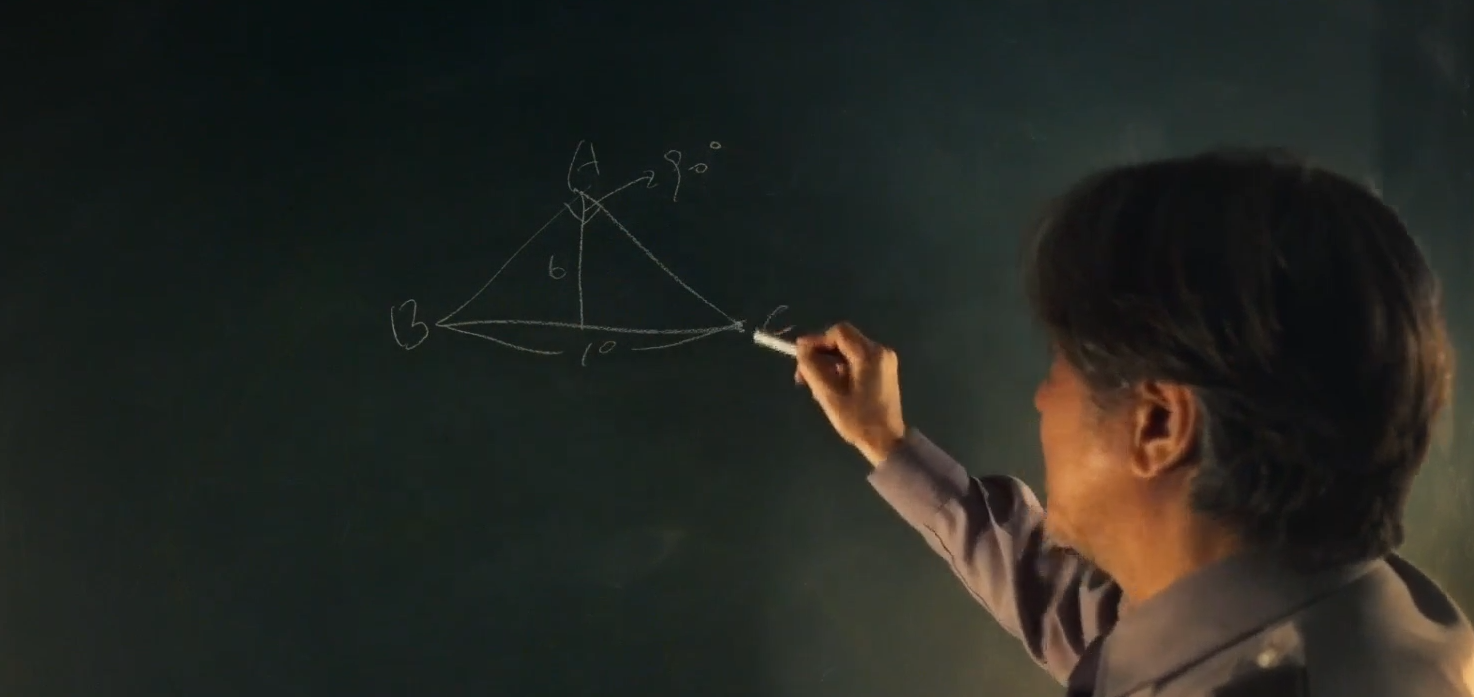


The third image says: "It is impossible to get a right answer from a wrong question."
Of course this scene was captured to teach him how to study math but it is very good example for our case
Introduction
In science and technology, precision is everything. But sometimes, the questions themselves lack precision or contain hidden assumptions, contradictions, or ambiguities. These are false questions: questions that are flawed by design, leading to confusion or unfair evaluation.
They may appear simple or straightforward, but they test not only knowledge but also the ability to spot inconsistencies.
Example from CCNA Knowledge Test: The Subnet Mask Dilemma
I recently came across a question in a CCNA (Cisco Certified Network Associate) knowledge assessment that perfectly illustrates this issue:
“A site administrator manages a network that must accommodate 126 hosts. Which subnet mask would satisfy the number of hosts requested?”
A. 255.255.255.0
B. 255.255.255.128
At first glance, both answers are technically valid:
- 255.255.255.0 supports 254 usable hosts — more than enough.
- 255.255.255.128 supports 126 usable hosts — exactly what's required.
So what’s the right answer?
That depends on the intended goal of the question — which is not clearly stated.
- If the purpose is to test whether the student can pick the smallest subnet that fits exactly 126 hosts, then 255.255.255.128 is correct.
- But if the purpose is to test whether the student is aware that networks often require room for growth, and that you should avoid maxing out a subnet, then 255.255.255.0 is the wiser choice.
The real problem is that the question does not clarify its intent. There is no mention of:
- Planning for future hosts
- Choosing the most efficient option
- Avoiding subnet exhaustion
So a student can think carefully, defend their reasoning — and still be marked wrong based on an unstated expectation.
This transforms a good teaching opportunity into a trap question.
Why False Questions Are Harmful
- They confuse learners and penalize those who think critically.
- They promote guesswork rather than true understanding.
- They can undermine confidence in assessments and educators.
- They encourage rote memorization instead of logical analysis.
Common Characteristics of False Questions
- Ambiguous wording without clear constraints.
- Multiple correct answers without instruction to choose all that apply.
- Hidden or unstated assumptions.
- Logical or physical impossibilities within the question.
- Mixing incompatible categories or units.
How to Avoid or Fix False Questions
- Clearly define requirements and constraints.
- Avoid vague terms like “best,” “ideal,” or “suitable” without context.
- Ensure internal consistency and real-world feasibility.
- If multiple answers are valid, ask for all correct options or specify criteria.
- Peer-review questions to spot ambiguities and logical flaws.
Conclusion
Good questions lead to clarity and deeper understanding. False questions mislead, confuse, and frustrate.
Whether in geometry, networking, or any scientific discipline, precision in questioning is essential. Sometimes the best answer to a question is to recognize that the question itself is broken.
“Sometimes, the smartest answer is: This question is flawed.”